U.S. forces—Mohamed Farrah Aidid
Black Hawk DownThe conflict between U.S. forces and Mohamed Farrah Aidid’s movement is presented as both a military campaign against a named leadership and a widening confrontation with the community around it. On October 3, 1993, a planned capture raid in Mogadishu brought that tension into sharp focus: American forces sought Aidid’s lieutenants, while Somali opposition was already preparing to prevent the assault force from leaving by road.
Origins and Objectives
By midafternoon, a company of Rangers was supporting a commando squadron sent to a gathering of Habr Gidir clan leaders in the heart of Mogadishu. The book describes the clan as led by warlord Mohamed Farrah Aidid, whose challenge to the United States had made its leadership the target of repeated operations. The immediate objective was specific: commandos would storm the target house and capture two senior lieutenants. Rangers would fast-rope down at the four corners of the block, establish a perimeter, and keep anyone from entering or leaving until the prisoners and assault team could be taken away.
The plan depended on a coordinated air-and-ground force. About 75 Rangers and 40 commandos traveled in 17 helicopters; a separate convoy of 12 vehicles waited at the airport to reach the target building and return with the prisoners and assault team. This was the unit’s sixth mission since arriving in Mogadishu in late August. Its commander, Maj. Gen. William F. Garrison, accepted the risk of a daylight operation in the Bakara Market area, which the account identifies as a stronghold of Aidid supporters. The operation’s capture objective and its exposed extraction route were therefore inseparable: once the Rangers descended, their return depended on a vehicle column moving through the city.
A Campaign Seen from Both Sides
The operation’s military logic collided with a history that Somali residents experienced not as a single raid but as a growing assault on their community. Abdikarim Mohamud, a secretary for an American support company working under the United Nations command, had initially welcomed the humanitarian mission: it had given him his first chance to use his fluent English at work. But the Rangers’ arrival and the attacks on the Habr Gidir clan and its leader, Mohamed Farrah Aidid, changed his view. He saw a mounting toll of Somali dead and wounded as an unwarranted assault on his country.
The July 12 attack on Abdi Qeybdid House had made that change personal and concrete. Missiles fired from American helicopters killed dozens of moderate clan leaders. Abdikarim saw wounded elders from his clan brought to the U.S. Embassy compound, where Americans photographed and interrogated them before putting them in jail. He kept his job, but took on another purpose: acting as his clan’s eyes and ears. The conflict was thus carried not only by armed forces and commanders but through local relationships, work, and information moving between the embassy and the community.
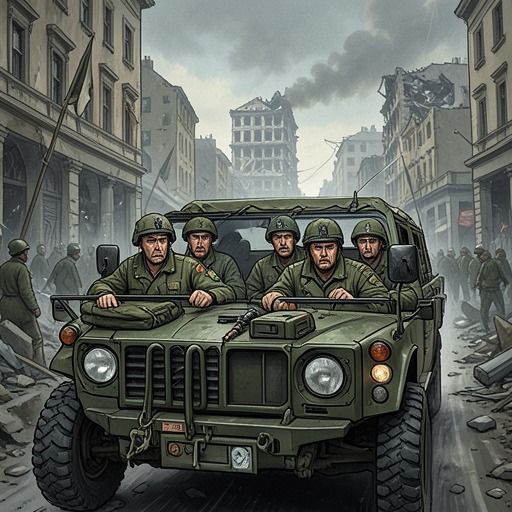
By the time the assault force took off on October 3, Abdikarim knew it was headed for Bakara Market. He understood the tactical consequence of the plan: after fast-roping in, the Americans would not be able to leave by helicopter and would need a vehicle column to extract them. Before the Rangers reached Hawlwadig Road, militiamen were preparing ambushes and roadblocks around the market. The extraction route that made the raid possible also gave its opponents a chance to trap the force in the city.
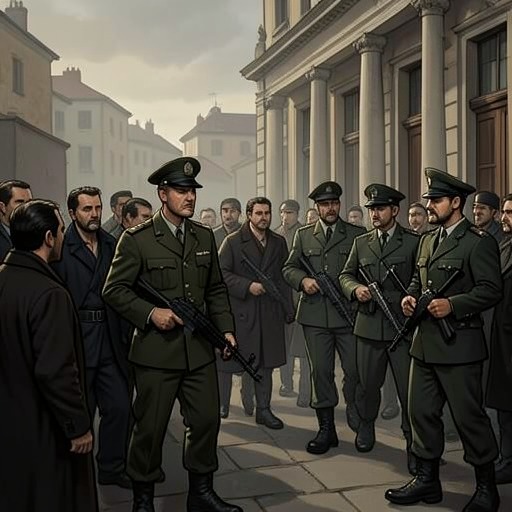
For the Rangers, the rules of engagement prescribed a narrow test: they were to fire only at someone pointing a weapon at them. In the crowded streets, that distinction became difficult to apply. Armed men mingled with women and children, while people of all ages gathered to watch disturbances; meanwhile, earlier Ranger missions had stirred widespread hatred. The account places the soldiers’ formal restrictions beside a city where armed resistance and ordinary presence were difficult to separate, and where the crowd itself could gather around the fighting.
That ambiguity became brutally immediate during the convoy’s passage through an alley. Eric Spalding saw a woman in a flowing purple robe carrying a baby and first shouted to the driver not to shoot. The woman turned and raised a pistol with her free hand. Spalding fired, then fired four more rounds as she fell; moving fast, he could not tell whether the baby had been hit, though he feared it had. The episode does not resolve the conflict’s civilian-combatant divide. Instead, it shows how quickly a warning, a perceived threat, and an irreversible act could occupy the same few seconds.
Escalation, Retaliation, and the Street
The conflict’s widening reach is visible in the changing conduct of the men sent into the city. Dale Sizemore had been eager to join the mission but had been kept at base by a cast on his arm; once he was in the battered column, that frustration gave way to anger and numbness. As the vehicles fought back toward the base, he saw boys, some armed and some not, and women alongside men carrying rifles. The account says he shot them all, no longer caring whether he was hit, because he wanted to get his Ranger friends back safely. His actions mark a stark departure from the rule that soldiers fire only at people pointing weapons: the immediate bond of comradeship and the desire to protect them had overtaken the distinction the rules were meant to preserve.
For Abdikarim Mohamud, the same fighting appeared from the streets rather than from the column. Near the shooting, he saw dead men, women, and children, and an American soldier wounded in the leg, trying to hide by the road. When a woman ran in front of him, the soldier fired in her direction and she was hit; moments later, a Little Bird helicopter flew low down an alley firing, with bullets kicking dust past Abdikarim as he pressed himself against a stone wall. After it passed, Somali men with rifles ran toward the corner to shoot at the American. The sequence places civilian exposure, American fire, and armed Somali resistance within the same confined streets, without making the danger or responsibility disappear on either side.
These perspectives show how the confrontation escaped the limits of its original capture objective. For the Rangers, the pressure to protect wounded and threatened comrades could turn restraint into indiscriminate violence; for residents, the advancing force brought death into ordinary streets and homes, while armed men moved toward the Americans. The conflict between U.S. forces and Mohamed Farrah Aidid’s movement consequently appears not only as a contest with a leadership, but as a battle whose methods and consequences drew the surrounding population into its path.
Fear, Command, and the Decision to Continue
The battle unsettled the Rangers in different ways, exposing the distance between unit identity and an individual’s capacity to keep fighting. Steve Anderson, a Ranger from Illinois and friend of Dale Sizemore, had once shared the unit’s eager spirit. A few weeks before the raid, shrapnel had wounded his legs during a night mission; now, hearing gunfire and radio traffic from the base, he felt sick with fear. The repeated calls over the radio seemed to him like an attempt to hold together a situation slipping away. Seeing Dominick Pilla dead and Todd Blackburn badly injured made the danger immediate. Anderson wondered what they were doing there and dreaded being sent back into the city, though he did not show his fear.
Brad Thomas’s decision brought that private struggle into the open. After riding back with Pilla’s blood on him, he had resolved that he could not face another trip into Mogadishu. He told Struecker that he could not go back out. The men around them expected the by-the-book sergeant to react angrily, but Struecker drew Thomas aside and spoke quietly. He acknowledged that he, too, was afraid and had never faced a situation like this, then urged Thomas to go because it was their job. Thomas walked away without appearing persuaded; when the vehicles were about to leave, however, Struecker saw that he had climbed aboard. The episode makes continued service neither effortless nor simply voluntary: fear was real, while duty and the presence of the unit pressed toward action.
That pressure did not eliminate disagreement about what action was possible. When Mike Steele told Sean Watson to prepare to move out, Watson challenged his captain directly. Five wounded men would have to be moved, two of them carried, and Earl Fillmore’s body also had to be transported. Four men carrying each litter would form a concentrated target for bullets and grenades as they left the building. Watson argued that the force had a well-defended courtyard and that abandoning it for the exposed streets was foolhardy. His objection was grounded in the immediate tactical burden of the wounded and dead, not indifference to the men under threat.
The account also shows the force’s readiness to return to combat after the immediate fighting. The D-boys reached the hangar before the Rangers and were already cleaning weapons, checking equipment, and restocking ammunition, prepared to go back out. When Mike Steele returned and received the accurate casualty list, Glenn Harris saluted him with the words, “Rangers lead the way, sir.” Fear, dissent, and exhaustion remain part of the scene, but the closing gestures restore the language of unit identity and the expectation of continued service.